

6. Modelling Week, 2024
In this seminar, students solved complex problems from industry and business using a wide variety of techniques such as mathematical modeling, numerical methods, and reinforcement learning.
Academic supervisors: Sandra Aziz (Scientific Computing), Maximilian Bauer (Scientific Computing), Markus Büttner (Scientific Computing), Tobias Rosnitschek (Chair of Engineering Design and CAD), Christina Schwarz (Scientific Computing)
Final Presentations: 18.09.2024 to 20.09.2024
Location: Wellness & Sporthotel Zur Post, Tännesberg
Participants: 16 Students of the Elite master's program Scientific Computing
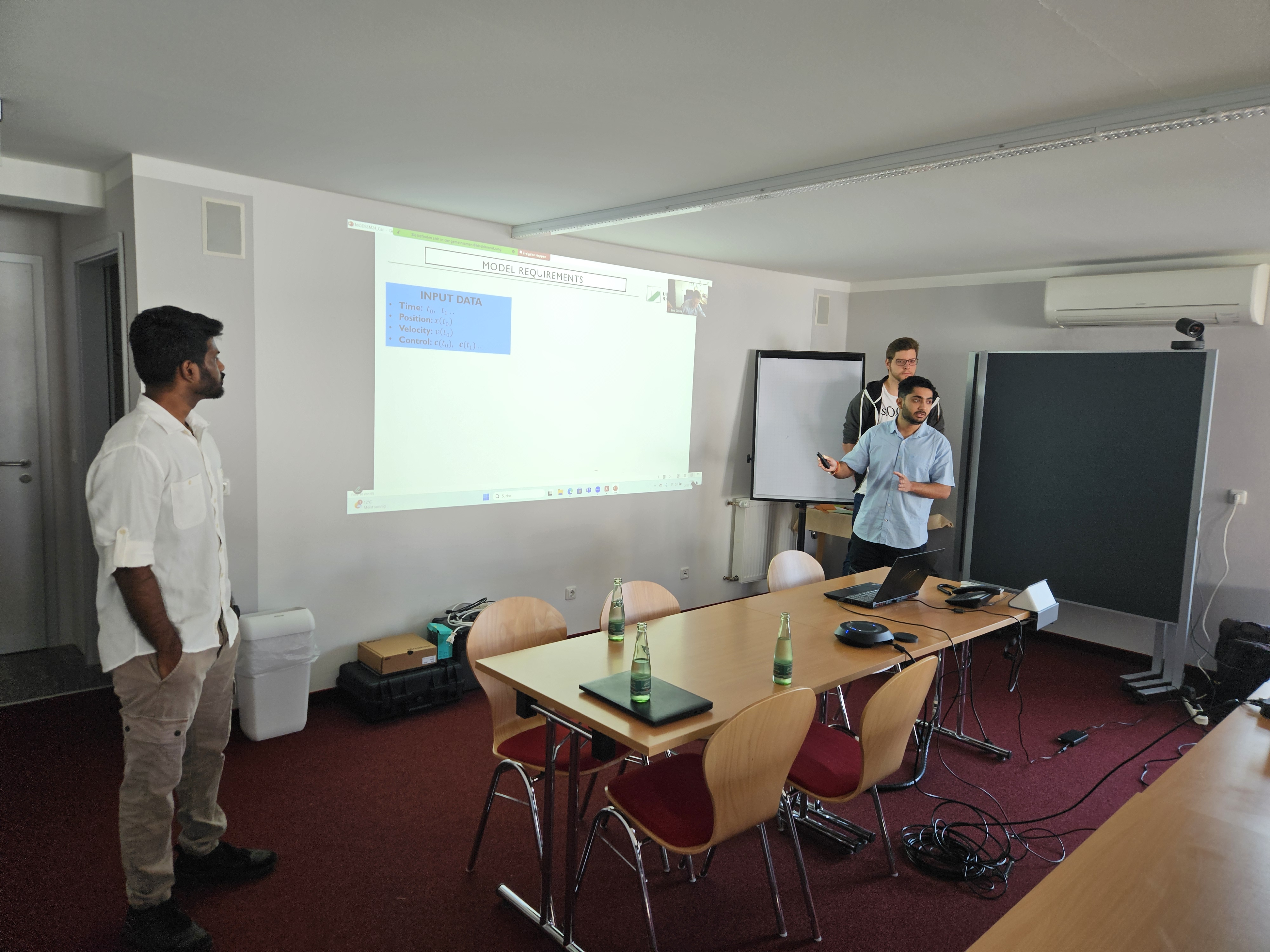
Students present their results in a talk.
The following topics, amongst others, were addressed:
Modeling and Control of a Carrera Car
This project focuses on the development of a physics-based mathematical model for the simulation and control of a Carrera slot car. Slot cars are guided by a slot in the track and driven by an electric motor, requiring precise control to maintain stability and avoid crashes, particularly during high-speed cornering.
The objective of the project is to create a dynamic model capable of accurately describing the vehicle’s motion and to implement a crash detection algorithm that predicts loss-of-control situations. The model incorporates key physical parameters influencing the car dynamics, including vehicle motion, track interaction, and cornering behavior.
Track geometry is represented using spline-based methods, enabling an accurate description of both curved and straight track sections. Numerical simulations are used to analyze the vehicle’s velocity, position, and orientation over time under varying control inputs and track conditions.
The developed framework provides a basis for investigating driving stability, evaluating control strategies, and optimizing race performance through predictive crash detection and dynamic simulation.
Domain Decomposition Methods in CFD Simulations
Computational Fluid Dynamics (CFD) simulations are widely used across various engineering disciplines to analyze and solve complex fluid flow problems. One of the major challenges in large-scale CFD simulations is the efficient management of the required computational resources. This challenge becomes even more significant in simulations involving highly refined meshes, where the number of computational cells can easily reach millions.
A key aspect of efficiently handling such simulations is the decomposition of the computational domain, or mesh, into smaller subdomains. This process, commonly referred to as domain decomposition, plays a crucial role in parallel computing environments, where multiple processors operate simultaneously to solve the problem.
The challenge addressed in this project is the partitioning of CFD meshes in a manner that minimizes the communication overhead between subdomains while satisfying predetermined geometric partitioning constraints. The objective is to reduce the communication load across subdomain interfaces and thereby improve overall computational efficiency.
The aim of this project is to explore, implement, and evaluate various domain decomposition methods under constraints that are typical for CFD simulations.
Prediction of Hot Clamp Losses of Compression Springs by Machine Learning Methods
The phenomenon of spring relaxation, defined as the gradual decrease in the force exerted by springs under constant load over time, has a significant impact on the performance and reliability of many mechanical systems. Accurate prediction of this force reduction is essential for ensuring the durability and efficiency of components in industries such as automotive, aerospace, and manufacturing. This project focuses on developing predictive models to estimate force loss in springs, or hot clamp losses caused by relaxation, by applying machine learning methods to improve prediction accuracy.
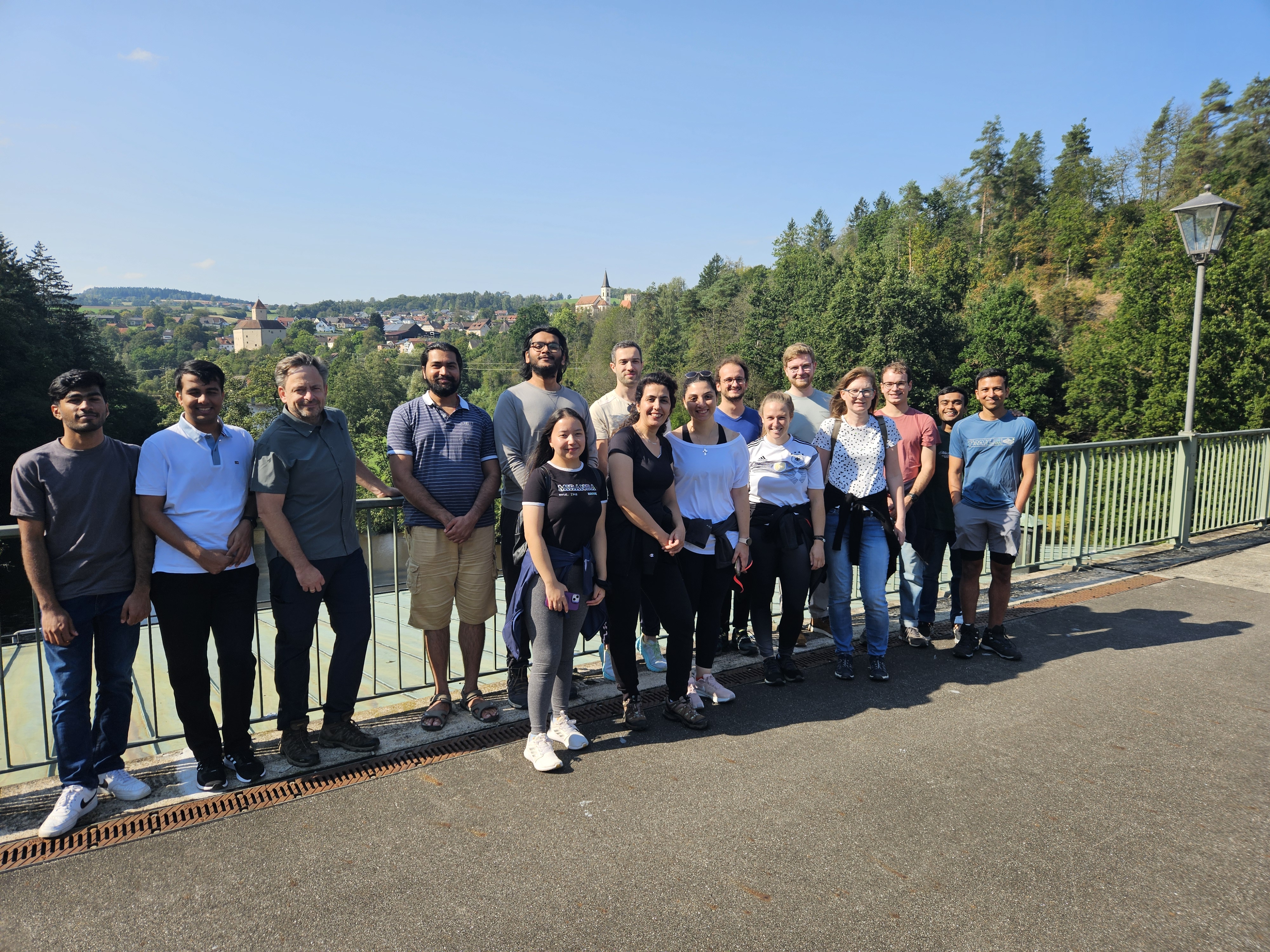
Hiking tour in the Oberpfälzer Wald near the seminar location.